GST Registration in India: When Is It Mandatory and What Happens If You Delay It?
GST Registration Is Usually Ignored Until It Becomes a Problem
Most business owners don't start their day thinking about GST registration. Their focus is usually on acquiring customers, generating sales, managing cash flow, hiring the right people, and growing the business.
GST often becomes important only when a client requests a GST invoice, an online marketplace asks for a GSTIN, or a notice arrives from the tax department.
By then, the discussion is no longer about compliance. It becomes about fixing a problem that could have been avoided.
Many entrepreneurs delay GST registration because they assume their turnover is still too small or believe registration can wait until the business grows. While that may be true in certain situations, many businesses unknowingly cross the point where registration becomes mandatory.
Understanding GST requirements early can help businesses avoid unnecessary penalties, tax liabilities, and operational disruptions.
What Is GST Registration?
Goods and Services Tax (GST) is India's unified indirect tax system applicable to the supply of goods and services.
Once registered, a business receives a unique Goods and Services Tax Identification Number (GSTIN), enabling it to operate as a GST-compliant business.
A GST registration allows businesses to:
Collect GST from customers.
Issue GST-compliant tax invoices.
Claim eligible Input Tax Credit (ITC).
File GST returns with the tax authorities.
Build credibility with clients and business partners.
For many startups and growing businesses, GST registration is not merely a legal requirement. It also demonstrates professionalism and improves trust among customers, vendors, and enterprise clients.
When Does GST Registration Become Mandatory?
One of the biggest misconceptions among business owners is that GST registration depends only on annual turnover.
While turnover is an important factor, it is not the only criterion.
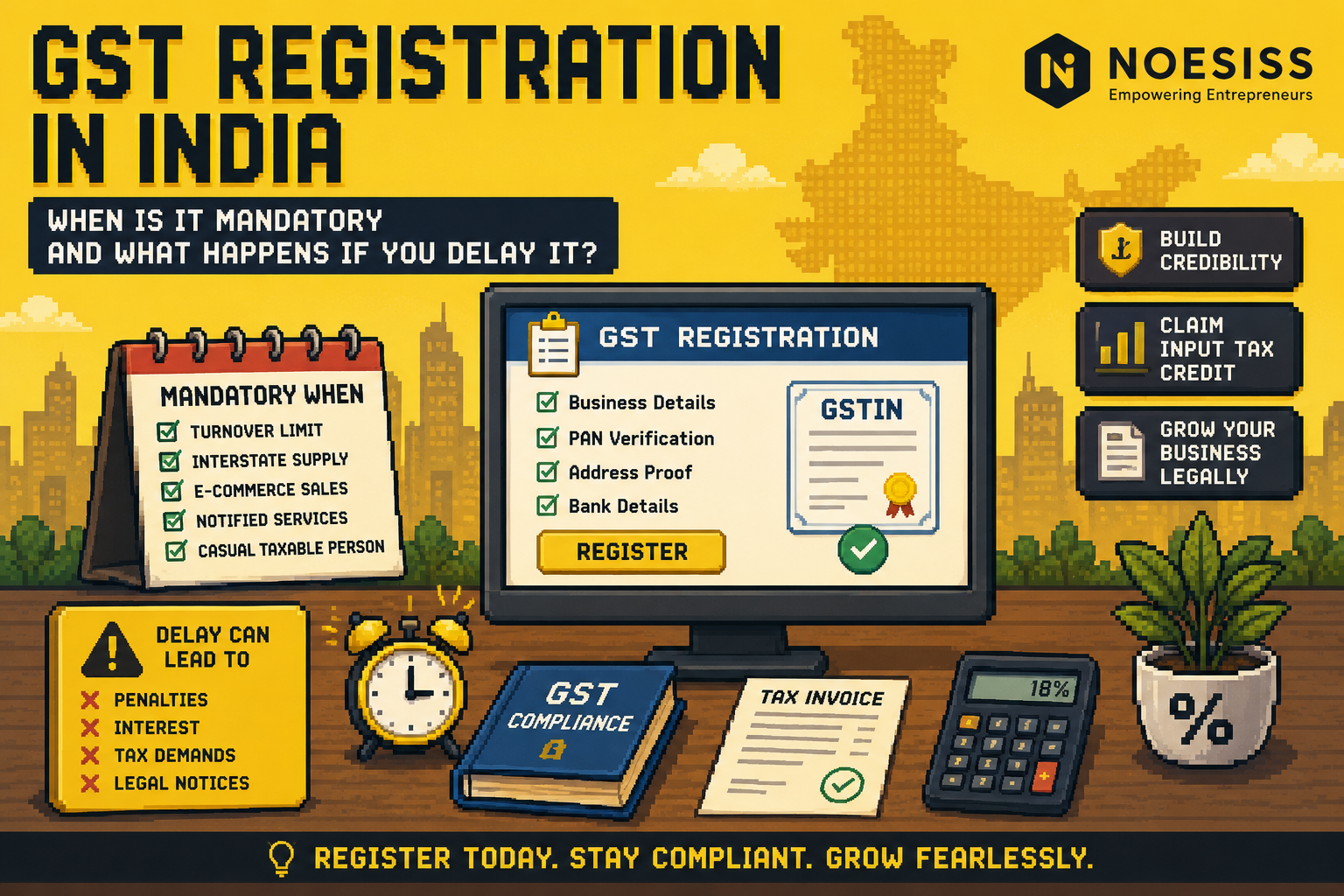
Registration may become mandatory if your business:
Exceeds the prescribed turnover threshold.
Makes interstate supplies of goods or services.
Sells through e-commerce marketplaces.
Falls under categories requiring compulsory registration under GST law.
Operates in businesses notified by the government.
Turnover limits may also vary depending on the nature of your business and the state in which you operate.
This is why every business should evaluate GST applicability based on its activities rather than relying solely on turnover figures.
Why Many Businesses Choose Voluntary GST Registration
Many businesses register for GST even before it becomes legally mandatory.
The reason is simple: credibility and growth.
Voluntary registration offers several commercial advantages, including:
Increased trust among customers.
Eligibility to claim Input Tax Credit (ITC).
Easier onboarding with corporate clients.
Better access to online marketplaces.
Improved financial transparency.
Higher confidence during vendor verification.
Many large companies prefer working only with GST-registered vendors because it simplifies their own tax compliance.
For startups planning long-term growth, voluntary registration often becomes a strategic business decision rather than just a compliance requirement.
Benefits of GST Registration
Registering under GST provides several long-term advantages beyond legal compliance.
Improved Business Credibility
A GSTIN demonstrates that your business operates within India's formal tax system. This increases confidence among customers, suppliers, financial institutions, and investors.
Input Tax Credit
Registered businesses can claim credit for GST paid on eligible purchases, reducing the overall tax burden and improving profitability.
Easier Business Expansion
Many government tenders, enterprise contracts, and online marketplaces require GST registration before allowing businesses to participate.
Better Financial Records
GST compliance encourages organized bookkeeping, structured invoicing, and transparent financial reporting.
Simplified Tax Framework
GST replaces multiple indirect taxes with a single tax system, making compliance easier than managing several different state and central taxes.
The Hidden Cost of Delaying GST Registration
Many founders focus only on the paperwork involved in GST registration.
Few consider the financial consequences of delaying it.
If GST registration becomes mandatory and a business continues operating without registering, several issues may arise.
These include:
Liability to pay GST on previous transactions.
Interest on delayed tax payments.
Monetary penalties.
Compliance notices from tax authorities.
Increased scrutiny during audits.
Difficulty recovering GST from customers after invoices have already been issued.
In many situations, businesses end up paying the tax from their own profits because customers cannot be billed retrospectively.
What initially appears to be a small delay can quickly become an expensive compliance issue.
Why Early Compliance Matters
Waiting until a customer requests a GST invoice or until a tax notice is received often leaves businesses reacting instead of planning.
Early GST registration offers peace of mind and allows founders to focus on growing the business rather than resolving avoidable compliance issues.
A proactive approach helps businesses:
Build trust with clients.
Avoid penalties and legal complications.
Maintain accurate financial records.
Expand confidently into new markets.
Prepare for future funding and business growth.
GST registration should be viewed as a business investment rather than merely a statutory obligation.
For many companies, registering early creates opportunities that extend well beyond tax compliance.
Common GST Registration Mistakes
Many businesses delay GST registration because they assume compliance can wait until the end of the financial year or until they receive a notice from the tax department. Unfortunately, these assumptions often lead to avoidable financial and operational challenges.
Some of the most common mistakes include:
Waiting until turnover has already exceeded the applicable threshold.
Assuming GST registration depends only on annual turnover.
Registering only after receiving a notice from the tax authorities.
Choosing incorrect HSN or SAC codes during registration.
Providing inaccurate business information or supporting documents.
Ignoring changes in business activities that may trigger compulsory registration.
Taking the time to evaluate GST applicability correctly at the beginning can prevent expensive corrections later.
Documents Required for GST Registration
The documents required vary depending on the type of business entity. However, most applicants will generally need:
PAN card of the business or proprietor.
Aadhaar card or identity proof.
Passport-size photograph of the applicant.
Business address proof.
Proof of business premises (owned or rented).
Bank account details or a cancelled cheque.
Email address and mobile number for OTP verification.
For Private Limited Companies and Limited Liability Partnerships (LLPs), additional documents are generally required, including:
Certificate of Incorporation.
PAN of the company.
Memorandum and Articles of Association (for companies).
LLP Agreement (for LLPs).
Board Resolution or Authorization Letter.
Identity and address proof of directors or designated partners.
Submitting accurate documents during the application process significantly reduces approval delays.
GST Compliance Does Not End With Registration
Obtaining a GST Identification Number (GSTIN) is only the beginning of your compliance journey.
After registration, businesses must continue meeting their statutory obligations by:
Filing GST returns on time.
Issuing GST-compliant invoices.
Maintaining accurate books of accounts.
Reconciling Input Tax Credit (ITC).
Paying GST within prescribed due dates.
Preserving financial records for future audits.
Consistent compliance helps businesses avoid penalties, notices, and disputes while improving financial transparency.
Businesses with a well-managed GST system also find it easier to secure funding, pass due diligence checks, and build long-term credibility with customers and investors.
How Noesiss Helps Businesses Stay GST Compliant
GST compliance can become overwhelming, especially for startups and growing businesses focused on expansion.
At Noesiss, we assist businesses through every stage of the GST lifecycle, including:
GST applicability assessment.
New GST registration.
GST amendments and updates.
Return filing and compliance management.
Input Tax Credit reconciliation.
GST advisory and notices.
Ongoing compliance support.
Our objective is not only to help businesses remain compliant but also to build systems that support sustainable and scalable growth.
Final Thoughts
GST registration is much more than a regulatory requirement.
It directly impacts your business credibility, taxation, customer relationships, financial reporting, and future growth opportunities.
Delaying registration may seem convenient today, but it can result in unnecessary penalties, tax liabilities, and operational complications tomorrow.
Whether you are a freelancer, startup, growing company, or established enterprise, understanding your GST obligations early enables you to make informed business decisions and remain compliant with confidence.
At Noesiss, we believe compliance should support growth, not slow it down. Our team works closely with founders and businesses to simplify GST registration, streamline compliance, and create a strong legal foundation for long-term success.
Investing in compliance today helps build a stronger, more resilient business for tomorrow.