The Most Common ITR Filing Mistakes in AY 2026-27 and How to Fix Every One of Them
Small Filing Mistakes Can Lead to Bigger Tax Problems
Every year, millions of Income Tax Returns (ITRs) are filed across India. While most taxpayers successfully complete the process, a significant number of returns contain mistakes that lead to notices, delayed refunds, incorrect tax calculations, or additional compliance requirements.
The majority of these errors are not caused by complicated tax laws.
They happen because taxpayers:
Rush their filing at the last minute.
Rely entirely on pre-filled data.
Choose the wrong ITR form.
Forget to report certain income.
Miss important verification steps.
As the Income Tax Department continues to strengthen its data analytics capabilities, even small inconsistencies between your Income Tax Return, Annual Information Statement (AIS), Form 26AS, and information reported by banks or employers can trigger automated notices.
The good news is that nearly all of these mistakes are preventable.
This guide explains the most common ITR filing mistakes for AY 2026-27, why they occur, and how you can avoid or correct them before they become expensive compliance issues.
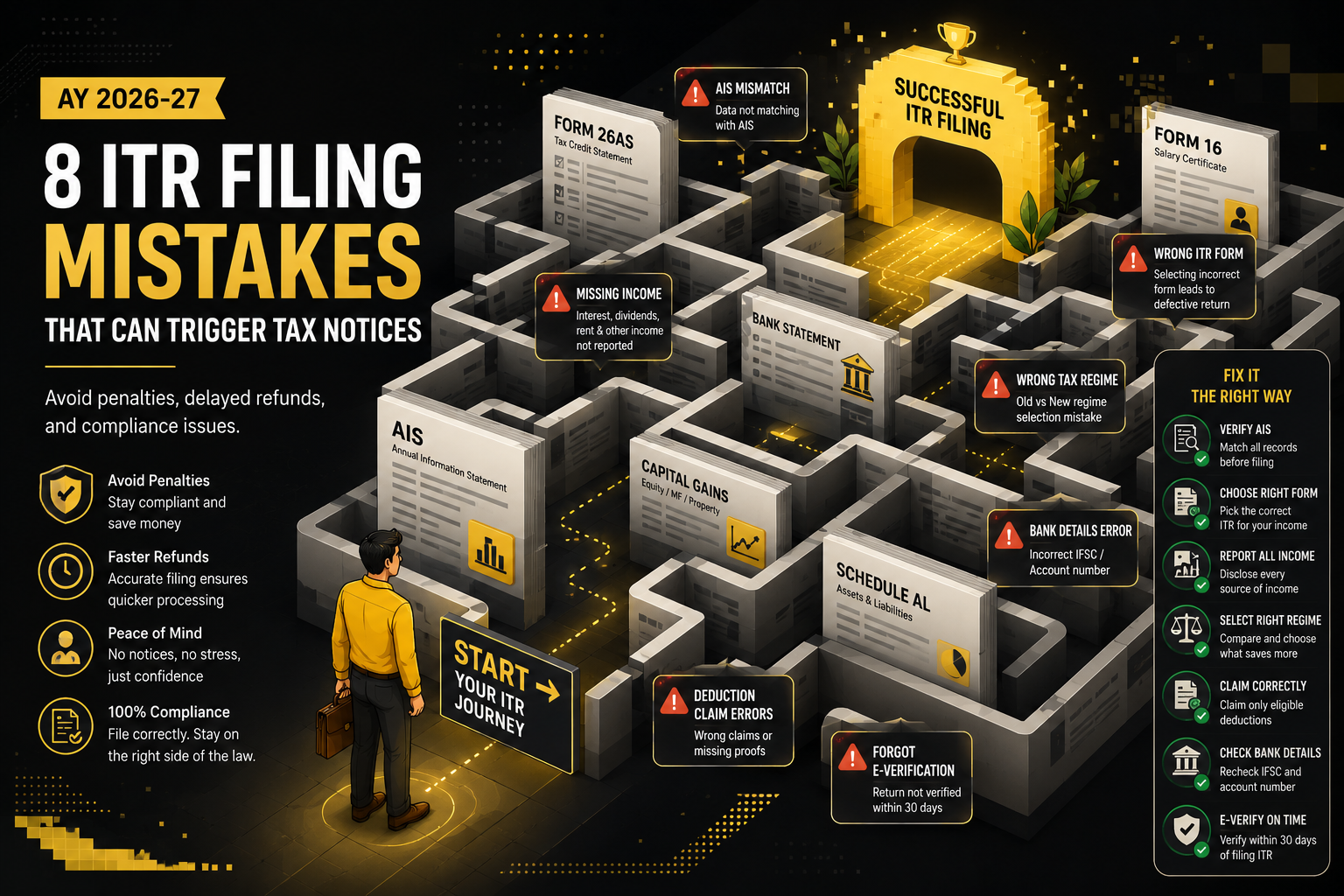
Mistake 1: Choosing the Wrong ITR Form
One of the most common filing mistakes is selecting the wrong Income Tax Return form.
India provides different ITR forms depending on the taxpayer's income sources and financial profile.
For example:
ITR-1 is suitable only for eligible individuals with straightforward income sources.
ITR-2 is generally used by individuals with capital gains or foreign assets but no business income.
ITR-3 is applicable where business or professional income exists.
ITR-4 is meant for taxpayers opting for the presumptive taxation scheme, subject to eligibility.
Choosing an incorrect form can result in:
Defective return notices.
Processing delays.
Additional compliance requests.
The need to revise the return.
How to Avoid It
Before selecting an ITR form, list every source of income, including:
Salary.
House property.
Capital gains.
Foreign assets.
Dividend income.
Business or professional income.
Crypto or virtual digital assets.
Selecting the correct form at the beginning prevents unnecessary complications later.
Mistake 2: Relying Only on Form 16
Many salaried taxpayers believe Form 16 contains everything required for filing an ITR.
It does not.
Form 16 only reports salary income and the tax deducted by your employer.
Your Annual Information Statement (AIS) and Form 26AS contain much broader information, including:
Savings account interest.
Fixed deposit interest.
Dividend income.
Mutual fund transactions.
Capital gains.
Property transactions.
Tax Deducted at Source (TDS) from multiple sources.
Ignoring these records often creates mismatches between your return and the information available with the Income Tax Department.
How to Avoid It
Before filing your return:
Download your latest AIS.
Download Form 26AS.
Compare both documents with your own financial records.
Reconcile every difference before submission.
This simple exercise significantly reduces the chances of receiving an automated notice.
Mistake 3: Not Reporting All Sources of Income
Many taxpayers unintentionally report only their primary source of income.
However, the Income Tax Return should include all taxable income earned during the financial year.
Commonly forgotten income includes:
Savings account interest.
Fixed deposit interest.
Dividend income.
Capital gains.
Freelance income.
Rental income.
Income from a previous employer.
Foreign income.
Even certain exempt income should be disclosed in the appropriate schedules where required.
How to Avoid It
Prepare a comprehensive list of every income source before filing your return.
Cross-check it with:
AIS.
Form 26AS.
Bank statements.
Investment statements.
Employer records.
Complete disclosure helps ensure accurate filing and minimizes the likelihood of future notices.
Mistake 4: Choosing the Wrong Tax Regime
The introduction of the new tax regime has created confusion for many taxpayers.
Some automatically file under the default regime without comparing the available options.
Others continue with the old regime without calculating whether the new regime would reduce their tax liability.
Before Filing, Compare Both Regimes
Review deductions such as:
Section 80C investments.
Section 80D health insurance.
Home loan interest.
House Rent Allowance (HRA).
Other eligible deductions.
Choosing the most beneficial regime after proper comparison can result in meaningful tax savings.
Mistake 5: Ignoring Form 26AS
Form 26AS is your official tax credit statement.
If TDS reflected in your return does not match Form 26AS, processing delays and notices may follow.
Always verify:
Employer TDS.
Bank TDS.
Professional receipts.
Advance tax.
Self-assessment tax.
If discrepancies exist, request corrections before filing your return.
Mistake 6: Forgetting to Complete E-Verification
Many taxpayers assume their return has been successfully filed once they click the Submit button.
However, filing your Income Tax Return is only half the process.
Your return must also be e-verified within the prescribed timeline. Without e-verification, the Income Tax Department considers your return invalid, which means it is treated as though it was never filed.
Failure to complete e-verification can lead to:
Delayed or cancelled refunds.
Notices from the Income Tax Department.
Additional compliance requirements.
The need to submit condonation requests.
How to Avoid It
Complete e-verification immediately after filing using any of the following methods:
Aadhaar OTP.
Net Banking.
Digital Signature Certificate (DSC).
Bank Account EVC.
Demat Account EVC.
Always verify that the return status on the Income Tax portal shows Successfully e-Verified.
Mistake 7: Incorrect Bank Details
Many taxpayers become eligible for an Income Tax refund but experience delays simply because incorrect bank details were entered while filing the return.
Even a minor mistake in your account number or IFSC code can prevent the refund from being credited.
Common mistakes include:
Incorrect account number.
Wrong IFSC code.
Closed bank account.
Account not pre-validated.
Incorrect account type.
How to Avoid It
Before submitting your return:
Verify your bank account number.
Confirm the IFSC code.
Ensure your account is pre-validated on the Income Tax portal.
Check that the account is active and linked to your PAN.
Taking a few minutes to verify these details can save weeks of follow-up later.
Mistake 8: Ignoring Schedule AL
Taxpayers with higher income often overlook Schedule AL (Assets and Liabilities).
Where applicable, this schedule requires disclosure of:
Immovable property.
Vehicles.
Jewellery.
Bank balances.
Investments.
Loans and liabilities.
Omitting mandatory disclosures may result in:
Defective return notices.
Additional scrutiny.
Delayed processing.
How to Avoid It
If your income requires Schedule AL reporting, prepare a summary of your assets and liabilities before filing.
Ensure every disclosure is complete, accurate, and supported by proper documentation.
How to Correct Mistakes After Filing Your Return
Mistakes can still happen despite careful preparation.
Fortunately, the Income Tax Act allows taxpayers to correct genuine errors.
File a Revised Return
If you discover an error after filing, you may submit a Revised Return within the prescribed timeline.
A revised return may be filed to correct:
Income reporting errors.
Incorrect deductions.
Wrong ITR form.
Missing income.
Incorrect bank details.
Capital gains calculations.
The revised return replaces the original return entirely.
Use an Updated Return (ITR-U)
If additional income is discovered after the normal filing period has expired, taxpayers may consider filing an Updated Return (ITR-U) where legally applicable.
An Updated Return allows voluntary correction but may involve additional tax and statutory conditions.
Professional advice is recommended before opting for this route.
Practical Checklist Before Filing Your ITR
Before clicking Submit, verify the following:
Correct ITR form selected.
All income sources disclosed.
Latest AIS downloaded and reconciled.
Form 26AS verified.
TDS credits matched.
Capital gains computed correctly.
Appropriate tax regime selected.
Deductions claimed accurately.
Bank details verified.
Return successfully e-verified.
A final review often prevents errors that could otherwise lead to notices or delays.
How Noesiss Helps
At Noesiss, we believe Income Tax filing should be accurate, stress-free, and fully compliant.
Our Income Tax professionals help individuals, startups, business owners, freelancers, and NRIs by providing:
Complete ITR preparation.
AIS reconciliation.
Form 26AS verification.
Capital gains computation.
Tax regime comparison.
Tax planning advisory.
Revised Return assistance.
ITR-U guidance.
Income Tax notice support.
End-to-end compliance assistance.
Every return is reviewed to ensure complete disclosure, correct tax computation, and timely filing.
Final Thoughts
Most Income Tax notices are not caused by complicated tax laws.
They are caused by avoidable mistakes.
Choosing the wrong ITR form, missing income disclosures, ignoring AIS, selecting the wrong tax regime, or forgetting e-verification can create unnecessary compliance issues.
Fortunately, each of these mistakes can be prevented with proper preparation and careful review.
Before filing your Income Tax Return, take the time to verify every detail, reconcile every income source, and ensure your return accurately reflects your financial information.
At Noesiss, we help taxpayers file confidently by combining technical expertise with practical guidance.
A few extra minutes of verification today can save months of correspondence tomorrow.