The First Business Decision That Impacts Everything
Most founders spend months refining their product, validating their idea, and planning their launch. Yet one of the most important decisions often gets made in a hurry.
What legal structure should your business operate under?
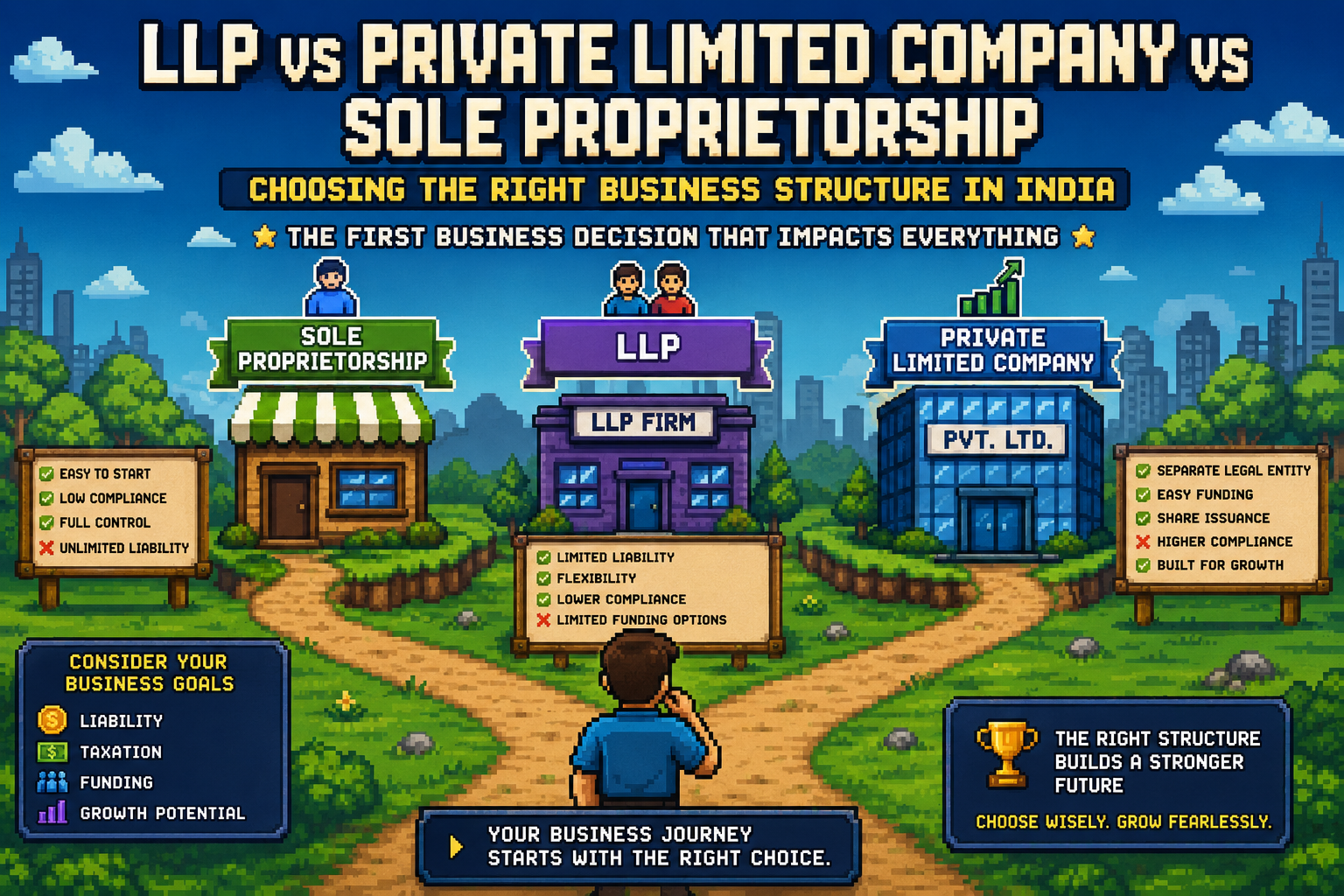
The choice between a Sole Proprietorship, Limited Liability Partnership (LLP), and Private Limited Company affects taxation, compliance requirements, fundraising opportunities, ownership structure, and long-term scalability.
Many entrepreneurs choose a structure based on recommendations or convenience. While simplicity matters in the beginning, the wrong structure can create expensive challenges later when the business starts hiring employees, raising investment, or expanding operations.
Understanding these differences early can save significant time, money, and administrative effort.
Understanding the Three Most Common Business Structures
In India, most businesses begin under one of these legal structures:
Sole Proprietorship - Owned and managed by one individual with no separate legal identity.
Limited Liability Partnership (LLP) - Combines partnership flexibility with limited liability protection.
Private Limited Company - A separate legal entity incorporated under the Companies Act, 2013, designed for scalable businesses.
Each structure serves different business goals and growth ambitions.
Sole Proprietorship: The Simplest Way to Start
A Sole Proprietorship is the easiest business structure to establish. The owner operates the business in their personal capacity without incorporating a separate legal entity.
Best suited for
Freelancers
Consultants
Content creators
Designers
Tutors
Local service providers
Advantages
Easy and inexpensive to start
Minimal compliance
Simple accounting and tax filing
Complete business control
Limitations
The biggest disadvantage is unlimited liability.
Since the owner and business are legally the same entity, personal assets such as savings, investments, and property may be exposed if the business incurs debt or legal claims.
It also becomes difficult to:
Raise funding
Bring investors on board
Issue shares
Transfer ownership
Limited Liability Partnership (LLP): Flexibility with Protection
An LLP bridges the gap between a traditional partnership and a company.
Unlike a Sole Proprietorship, an LLP has its own legal identity while partners enjoy limited liability protection.
Best suited for
Consulting firms
Law firms
Accounting firms
Agencies
Professional service businesses
Family-owned enterprises
Advantages
Limited liability protection
Separate legal entity
Lower compliance than companies
Flexible profit sharing among partners
Suitable for professional businesses
Limitations
LLPs cannot issue shares or ESOPs, making them less attractive to angel investors and venture capital firms.
Most startups planning external funding eventually convert into a Private Limited Company.
Private Limited Company: Built for Growth
Most high-growth startups in India operate as Private Limited Companies.
This structure provides a separate legal identity from its founders, offering strong liability protection and greater credibility with investors, banks, and enterprise customers.
Advantages
Separate legal entity
Limited liability
Ability to issue shares
Easier fundraising
ESOPs for employees
Strong corporate credibility
Suitable for rapid scaling
Compliance Requirements
Private Limited Companies require:
Annual ROC filings
Board meetings
Statutory registers
Financial statements
Companies Act compliance
Although compliance is higher, it creates a strong foundation for sustainable business growth.
Comparison at a Glance
FeatureSole ProprietorshipLLPPrivate Limited CompanyLegal EntityNoYesYesLimited LiabilityNoYesYesComplianceLowMediumHighFundraisingDifficultLimitedExcellentShare IssuanceNoNoYesESOPsNoNoYesBest ForFreelancersProfessional FirmsStartups & Growing Businesses
Which Structure Should You Choose?
Your decision should depend on your long-term vision.
Choose a Sole Proprietorship if you:
Want to start quickly
Operate independently
Have minimal compliance needs
Choose an LLP if you:
Have multiple partners
Need liability protection
Want operational flexibility
Choose a Private Limited Company if you:
Plan to raise funding
Want to build a team
Need ESOPs
Aim to scale nationally or globally
Think beyond today's convenience and choose a structure that supports your business over the next three to five years.
Common Mistakes Founders Make
Many entrepreneurs make avoidable mistakes, including:
Choosing a Sole Proprietorship because it is easy, then struggling with enterprise clients.
Registering a Private Limited Company before validating the business idea, resulting in unnecessary compliance costs.
Starting as an LLP without realizing that investors often require conversion to a Private Limited Company before funding.
Selecting the right legal structure early can prevent costly restructuring later.
Final Thoughts
Your business structure is far more than a registration formality. It influences:
Liability protection
Taxation
Regulatory compliance
Fundraising opportunities
Business credibility
Long-term scalability
Before registering your business, carefully evaluate your growth plans, funding requirements, and operational needs.
At Noesiss, we help entrepreneurs understand compliance obligations, evaluate business models, and choose the legal structure that best aligns with their long-term goals.
The right foundation today makes tomorrow's growth significantly easier.